The clocks go back one hour at 2 a.m. on Sunday, November 1, 2026, and that same day kicks off Ontario's Carbon Monoxide Awareness Week (November 1–7). The furnace is working hard again, so this is a good week to check the one safety device you can't do without: a working carbon monoxide (CO) alarm.
Here's a plain-language look at Ontario's CO alarm rules, which expanded on January 1, 2026, plus my simple SAFE home safety checklist. Whether you're in Durham Region, York Region or Toronto, the rules are the same across Ontario. There's also a section for anyone buying or selling a home this season.
This post is general information, not legal advice. For questions about your specific home, your local fire department is the best contact.
Why CO Awareness Week starts November 1
Ontario's Hawkins Gignac Act (Carbon Monoxide Safety), 2013 proclaims the week beginning on November 1 each year as Carbon Monoxide Awareness Week. The Act is named for the Hawkins family of Woodstock, who died of carbon monoxide poisoning in their home. The week was set to line up with the end of daylight saving time, so checking your alarms becomes part of changing the clocks (Hawkins Gignac Act, ontario.ca/laws).
Why carbon monoxide matters
Carbon monoxide is an invisible, tasteless and odourless gas, which is why it's called the "silent killer." It's produced when fuels like natural gas, propane, heating oil, gasoline or wood don't burn completely. Furnaces, gas or wood fireplaces, water heaters, stoves, barbecues, portable heaters, generators and vehicles can all produce it. According to the Province, over 65% of CO-related injuries and deaths in Ontario happen in the home (Ontario.ca).
The only way to detect CO is with a working CO alarm.
What changed on January 1, 2026
Ontario Fire Code changes that took effect on January 1, 2026 expanded where CO alarms are required in existing homes (Ontario.ca).
For houses (detached, semi-detached, townhouses and cottages), a CO alarm is required if the home has any of the following:
- a fuel-burning appliance, such as a gas furnace, water heater or stove
- a fireplace
- an attached garage
- heating by air from a fuel-burning appliance that isn't inside the home, such as one in a utility shed (new as of Jan 1, 2026)
If any of those apply, you need a CO alarm:
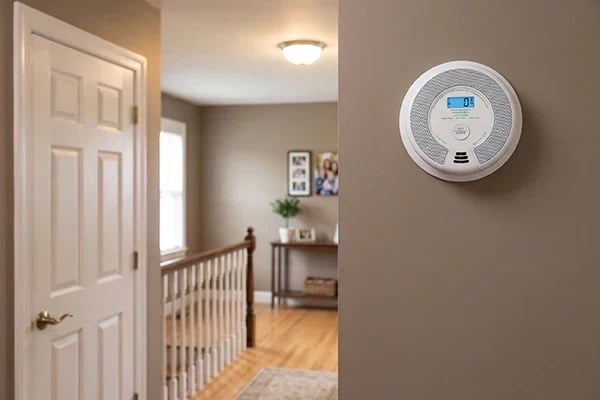
- next to each sleeping area, meaning the hallway or area outside the bedrooms, and
- on every storey of the home, including storeys with no bedrooms (new as of Jan 1, 2026).
That second point is the one that catches people. If you have a finished basement with a gas furnace and no bedrooms down there, it still needs a CO alarm (Ontario CO alarm rules for existing homes, PDF).
For condos and apartments, an alarm is required if your unit has a fuel-burning appliance or fireplace, sits directly above, below or beside a service room or garage, or is heated by air from a fuel-burning appliance outside the unit. Where required, alarms go next to each sleeping area and on every storey of the unit, and public corridors heated by a fuel-burning appliance need them too. If you own or rent a condo, check the Province's page or ask your property manager.
Who's responsible?
- Building owners and homeowners are responsible for meeting the Fire Code CO alarm requirements.
- Landlords must install and maintain CO alarms in rental units, test them every year, when the battery is replaced, when the electrical circuit changes and when a new tenant moves in, and give tenants a copy of the maintenance instructions.
- Tenants should tell their landlord about any problem with an alarm.
It's against the law for anyone to remove batteries from a CO alarm or tamper with it (Ontario.ca).
Smoke alarms are a separate rule. Every Ontario home must have a working smoke alarm on every storey and outside all sleeping areas (Ontario.ca, Fire safety at home). Hardwired, battery and plug-in CO alarms are all allowed, and combination smoke/CO units can make life simpler.
My SAFE checklist for clocks-back weekend
- S – Sound check. Press the test button on every smoke and CO alarm. The Province recommends testing CO alarms every month and replacing batteries every year. Check the end-of-life date and replace alarms according to the manufacturer's instructions. A chirp can mean a low battery or end of life, and your manual tells you which.
- A – Appliances and vents. Have your furnace, chimney, fireplace and other fuel-burning appliances cleaned and inspected by a professional before the cold sets in. Keep outside vents for the furnace, dryer, stove and fireplace clear of snow and debris. Open the flue before you light a fireplace.
- F – Fuel engines stay outside. Never run a car, generator or barbecue in the garage, even with the door open, and never use a stove or oven to heat your home.
- E – Escape plan. Practise your plan with the whole household, and make sure everyone knows the difference between the smoke alarm and CO alarm sounds.
When you buy a new alarm, look for the mark of a recognized testing agency such as CSA, ULC or ETL. And while you're charging phones, e-bikes and tools this winter, use the charger that came with the device and don't charge on beds, couches or in front of exits (NFPA, 2026 Fire Prevention Week).
If a CO alarm goes off, get everyone outside right away and call 9-1-1 from outside the home.
Buying or selling this fall? Check the alarms
Sellers: Before you list, walk every storey and confirm there's a working smoke alarm and, where required, a CO alarm. Check the end-of-life dates too. It's a small, inexpensive job, and it's one less item to come up during a buyer's home inspection. If you're a landlord selling a tenanted property, keep a record of your annual testing.
Buyers: Add alarms to your walkthrough. On every floor, look for a smoke alarm and, if the home has gas appliances, a fireplace or an attached garage, a CO alarm. Ask your home inspector to note their condition. Once you have the keys, test or replace them on day one, since you don't know how old they are.
I'm always glad to talk this through. Asking about safety is never a silly question.
Get my free SAFE home safety checklist
Want the printable version? Send me a message or email me at [email protected] and I'll send you my free one-page SAFE home safety checklist. It's made to stick on the fridge.
Andrew Persaud, Sales Representative, REVEL Realty Inc., Brokerage 📞 416-220-7045 ✉️ [email protected] #200B – 1032 Brock Street S, Whitby, ON L1N 4L8
This article is for general information only and is not legal, fire-code or inspection advice. For requirements that apply to your property, contact your local fire department. Not intended to solicit buyers or sellers currently under contract.
Sources (re-checked Oct 26, 2026)
- Government of Ontario, Carbon monoxide safety (updated Dec 30, 2025): https://www.ontario.ca/cosafety
- Government of Ontario / Office of the Fire Marshal, Carbon Monoxide Alarm Rules: Existing Homes (Dec 2025, PDF): https://www.ontario.ca/files/2025-12/solgen-co-alarm-requirements-homes-en-2025-12-17.pdf
- Hawkins Gignac Act (Carbon Monoxide Safety), 2013, S.O. 2013, c. 14: https://www.ontario.ca/laws/statute/13h14
- Government of Ontario, Fire safety at home: https://www.ontario.ca/page/fire-safety-home
- NFPA, 2026 Fire Prevention Week theme: https://www.nfpa.org/about-nfpa/press-room/news-releases/2026/2026-fire-prevention-week-theme-announced